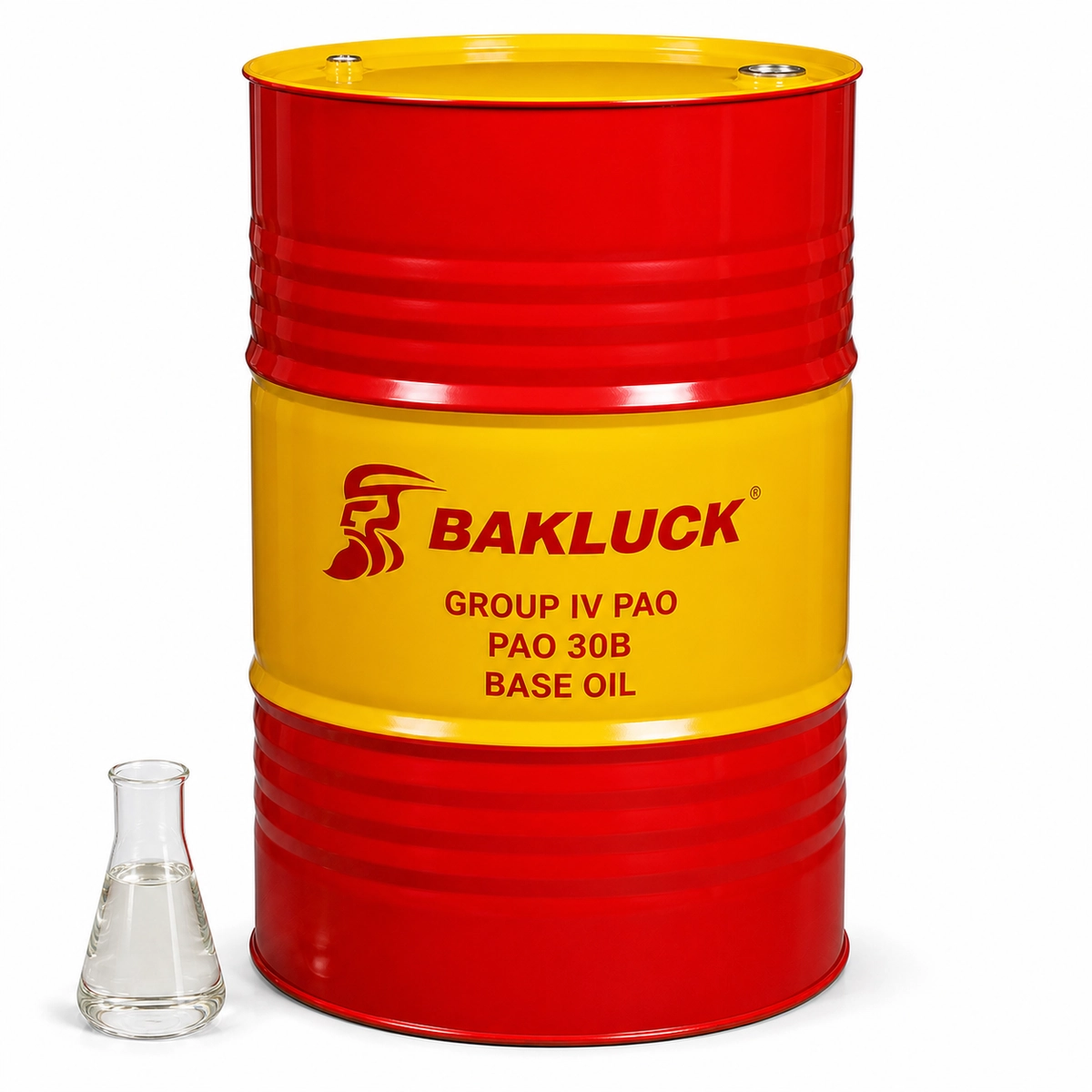
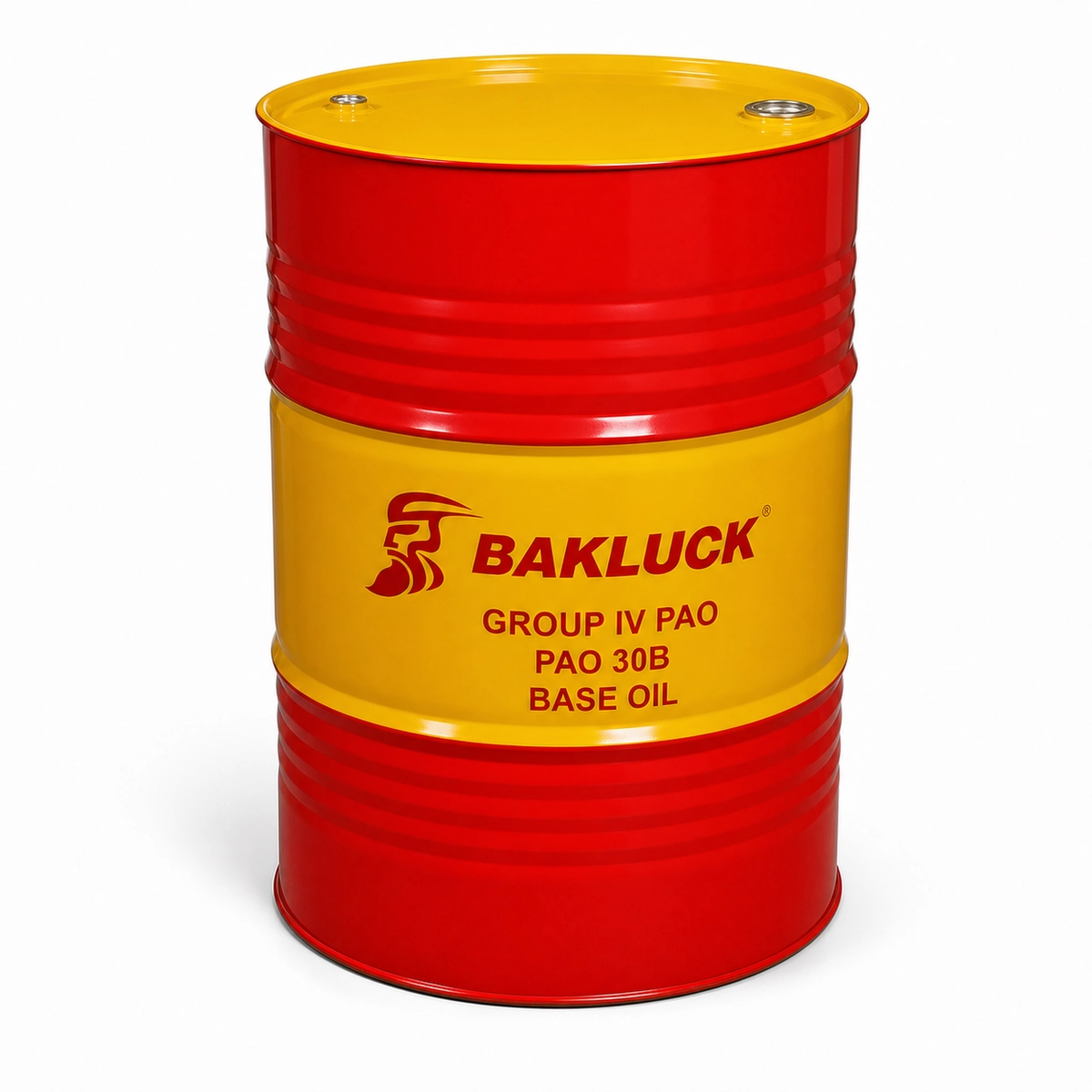
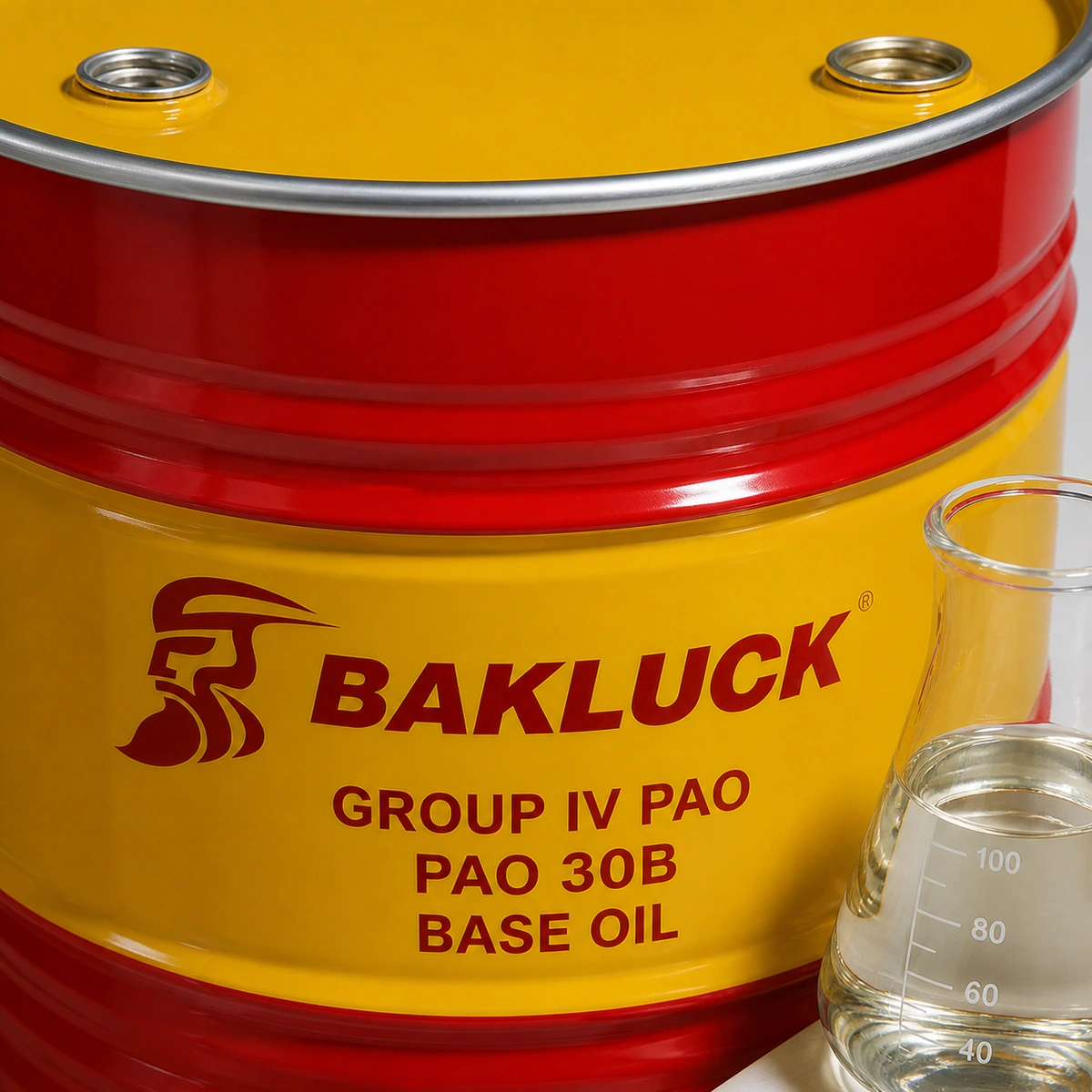
Formulators seeking PAO formulations that use defined viscosity, temperature response and volatility to build a synthetic-fluid profile can evaluate BAKLUCK PAO 30B through its reported property pattern. The source identifies density at 15.6 °C of 0.836 g/cm³ by ASTM D1298; it also gives kinematic viscosity at 100 °C of 29.35 mm²/s by ASTM D445, with kinematic viscosity at 40 °C of 269.2 mm²/s by ASTM D445 completing a useful three-point picture. This makes the PAO 30B synthetic hydrocarbon base stock a candidate for high-viscosity industrial gear-oil development and a comparison option for grease-formulation and synthetic-fluid viscosity-building trials. The table supports screening only, because additive chemistry and blend ratios determine the delivered lubricant performance. Complete compatibility, durability and specification testing, and request both the current BAKLUCK TDS and the applicable batch COA before finalizing the product.
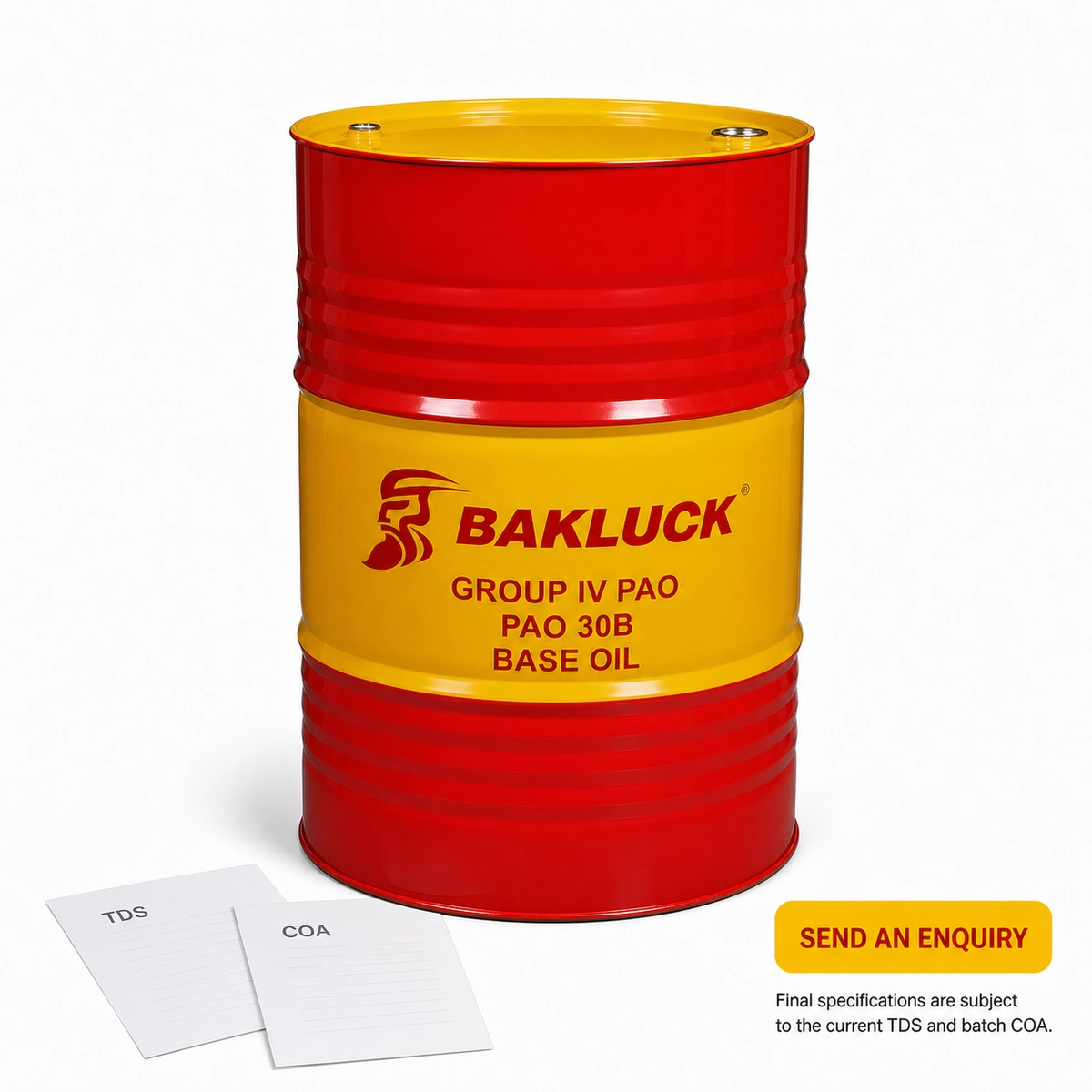
PAO 30B
With 29.35 mm²/s 100 °C viscosity, PAO 30B occupies a defined viscosity position during evaluation of high-viscosity industrial gear-oil development.
Product overview
Formulators seeking PAO formulations that use defined viscosity, temperature response and volatility to build a synthetic-fluid profile can evaluate BAKLUCK PAO 30B through its reported property pattern. The source identifies density at 15.6 °C of 0.836 g/cm³ by ASTM D1298; it also gives kinematic viscosity at 100 °C of 29.35 mm²/s by ASTM D445, with kinematic viscosity at 40 °C of 269.2 mm²/s by ASTM D445 completing a useful three-point picture. This makes the PAO 30B synthetic hydrocarbon base stock a candidate for high-viscosity industrial gear-oil development and a comparison option for grease-formulation and synthetic-fluid viscosity-building trials. The table supports screening only, because additive chemistry and blend ratios determine the delivered lubricant performance. Complete compatibility, durability and specification testing, and request both the current BAKLUCK TDS and the applicable batch COA before finalizing the product.
Typical reference values
| Property | Typical value | Method |
|---|---|---|
| Appearance | Clear transparent liquid | Visual |
| Density at 15.6 °C | 0.836 g/cm³ | ASTM D1298 |
| Kinematic viscosity at 100 °C | 29.35 mm²/s | ASTM D445 |
| Kinematic viscosity at 40 °C | 269.2 mm²/s | ASTM D445 |
| Viscosity index | 146 | ASTM D2270 |
| Flash point (COC) | 244 °C | ASTM D92 |
| Pour point | -47 °C | ASTM D97 |
| ASTM color | <0.5 | ASTM D1500 |
| Odor | Odorless | ASTM D1296 |
| Acid number | 0.01 mg KOH/g | ASTM D974 |
| Water content | <100 ppm | ASTM D6304 |
| Evaporation loss at 150 °C for 24 h | 1.01 % | ASTM D972 |
Applications
- High-viscosity industrial gear-oil development
- Grease-formulation and synthetic-fluid viscosity-building trials
Frequently asked questions
Which development path fits PAO 30B's reported viscosity?
Initial selection can start at 29.35 mm²/s 100 °C viscosity. Laboratory work on high-viscosity industrial gear-oil development should verify that the blended viscosity and performance targets are met.
What must be confirmed before specifying PAO 30B?
For PAO 30B, match the formulation target to the current BAKLUCK TDS, then verify the supplied lot on its batch COA before approval.
Final specifications are subject to the current TDS and batch COA.
Product Details
Formulators seeking PAO formulations that use defined viscosity, temperature response and volatility to build a synthetic-fluid profile can evaluate BAKLUCK PAO 30B through its reported property pattern. The source identifies density at 15.6 °C of 0.836 g/cm³ by ASTM D1298; it also gives kinematic viscosity at 100 °C of 29.35 mm²/s by ASTM D445, with kinematic viscosity at 40 °C of 269.2 mm²/s by ASTM D445 completing a useful three-point picture. This makes the PAO 30B synthetic hydrocarbon base stock a candidate for high-viscosity industrial gear-oil development and a comparison option for grease-formulation and synthetic-fluid viscosity-building trials. The table supports screening only, because additive chemistry and blend ratios determine the delivered lubricant performance. Complete compatibility, durability and specification testing, and request both the current BAKLUCK TDS and the applicable batch COA before finalizing the product.
Additive Technology
International Premium Additive Package